Do you think I'm human? (because Facebook doesn't)
I haven’t been able to use Facebook for more than a week. Why not? Because it doubts that I’m human. Tragic, right?
The situation
Last week I received an email:
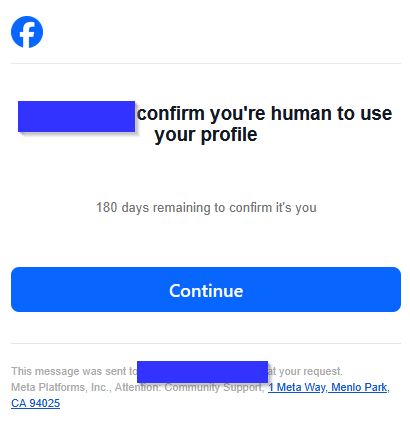
This was a surprise given I’d literally been using Facebook five minutes before. It felt like it had to be a scam email. But it wasn’t.
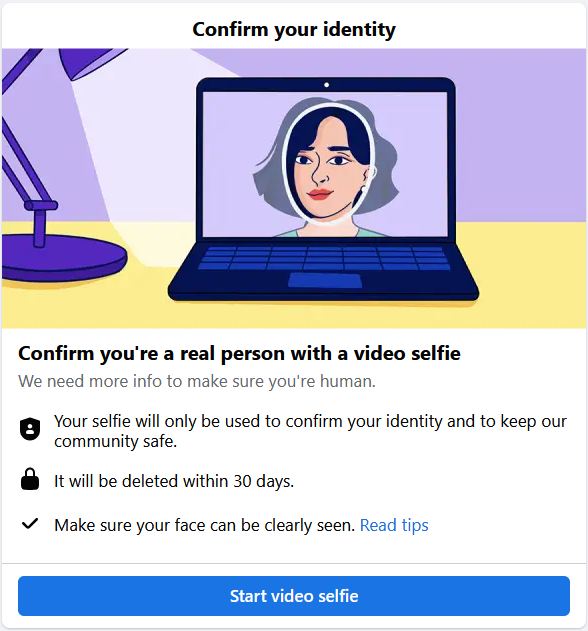
After a short period, Facebook on both computer and phone showed nothing but this:
Five hours later I received another email telling me my access to advertising has been restricted:
We’ve noticed some unusual activity on your Facebook account and have restricted its access to advertising.
This feels a bit unnecessary given I’ve never run an ad on Facebook, but I guess it shows they’re being thorough?
We used technology to detect this violation and carry out this decision.
That makes me feel so much better…
What did you do?
Facebook aren’t in the business of giving reasons for excluding people. And since they’ve blocked my access it’s not like I can check for sure what I did.
But what I recall is this:
- The day before I’d posted my latest post about Christadelphians to an ex-Christadelphian group I’m part of.
- During the day I probably opened Facebook on my phone and scrolled the feed randomly a few more times than was good for me.
- In the minutes before being blocked, I responded to a comment on my post from point 1.
Nothing unusual here
Obviously I can’t say for sure what caused this. All I can think of is that the “promote an external link” action could look like bot-like behaviour. But if so, it’s not just something bots do - it’s also something humans have been doing for years.
I’ve had a Facebook account for nearly twenty years (I can’t tell you the exact date because, y’know, they’ve locked me out). I’ve been a member of that particular group for nearly a decade. Over the years there I’ve shared a number of my posts about Christadelphia that I thought relevant, as well as interacting with other group members and other posts (for the record, the Christadelphian video I was responding to in the mortality insurance post was a video I’d seen because someone else in the group shared it).
I’ve been accessing Facebook from the same phone and the same computer and browser for well over a year. I very much doubt there was anything out of the normal in the hours, days, or weeks leading up to their action.
I don’t care how fancy the technology they’re using to detect unusual behaviour is: In this case it looks clearly wrong, and they should have accumulated enough information about me over the years to demonstrate that it’s wrong.
What exactly do you mean “Confirm your identity”?
Look at that blocker screen again:
They say two very different things:
-
We need to confirm you’re human
-
We need to confirm your identity
Both messages are included twice, and they’re not even close to the same thing. Either this is incredibly bad wording that they should be pilloried for, or it’s very deliberately saying that they’re not just interested in confirming that the user is human, but which human they are.
I don’t post photos of myself on Facebook that often. Actually, it wouldn’t surprise me if there are no photos of me from this decade. So I don’t think any video selfie can be used to “confirm my identity” - unless they attempt to match it with <whatever other datasets they have access to>. If they are doing that, I’d strongly object to it. It would also make deleting the video selfie within 30 days cold comfort if they’ve already achieved their purpose with it.
Last year, Discord’s “open and shut your mouth to prove you’re adult” felt stupid, but it also didn’t feel like a big deal. I’m guessing this is the same, and if after 30 days it’s as if the video selfie never existed, it’s annoying but not the end of the world.
But the reason I’m even thinking of the other possibility is because of the wording that they chose to use. They chose wording which leaves open the “deep surveillance and real world identity matching” option, and they did that knowing that there’s a proportion of the population that doesn’t trust them (if you think my words are over the top, you don’t have to look far to find people online who’ve encountered this screen and are way more paranoid about it than I am).
I looked at their privacy policy quickly to see if they made it clearer how they would use the video selfie, and I didn’t find it clear. They offer a link to “Manage the information we collect about you”. But that’s not functionality I’m able to use because - you guessed it - I’m locked out. This means they’re simultaneously making invasive demands for information I wouldn’t otherwise choose to give them, and blocking my ability to understand or control how they use that additional information. Not great.
One of the things they say they can use:
Your photo or video selfie if you provide it when you contact us for account support.
To me, “if you provide it” seems like a poor euphemism for “At our discretion, we will coerce you to provide it” (I doubt too many people are going to spontaneously decide “I’d love to share a video selfie with Facebook support” 😛). In addition, in spite of their nice screen saying the video selfie will be deleted within thirty days, nothing I could see in the privacy policy limits the ways they can use it or how long they can keep it.
Dance for us, human!
I find it somewhat ironic that their “human” verification process is almost certainly triggered by a bot on their side. The bot has got it wrong, but that still makes it the human’s problem, not the bot’s problem.
I object to them instituting a highly invasive process without clear safeguards. And I particularly object to the implication that we should immediately buckle down and comply.
Will their magic algorithm see my many refusals to go through the human verification process right now as proof that I’m really not human? Perhaps. If so, that’s their loss.
My response
Very probably, going through the video selfie process would be relatively quick and easy. Yes, there are stories online of Facebook either rejecting the video selfie or accepting it then later banning the account for a different reason, and that could happen. But I assume Facebook don’t want that to be too common in case it affects their bottom line. Writing this post will have taken me far longer, and still won’t get me access to my account (but at least it’s been an interesting post to write…).
However, to me there’s a principle at stake. Facebook is supposed to be in the information business. They should have all the information needed to know that I’m human and that my actions weren’t unusual for me. I don’t think Facebook should be able to make unreasonable demands like this without consequences to them. Rushing to comply with that unreasonable demand would be saying “Yes, sir, yes, sir, you’re so important to me that I’ll do anything you say, sir”, and I’m not going to do that.
It was incredibly tempting to say “Screw you, Facebook, I’m done” (they’ve certainly given me plenty of reasons to want out over the years…). But I’m also probably not going to do that.
Initially, I decided I definitely wouldn’t go through the process for at least a week. That meant that every time I reflexively clicked that Facebook button on my phone during that week, it would be a reminder of what Facebook has done. And let’s face it: I probably click that button way too often, so taking a break won’t hurt.
It’s now heading towards two weeks, and I seem to have survived - though I haven’t completely stopped clicking on Facebook from force of habit.
I have no idea what revenue Facebook has lost from me stepping away for a week, or what they would lose if I decide, say, to make it a month. In the big picture, probably not that much. That’s not the point, though: I think they’ve made bad choices, and they should face consequences for that. Denying them my attention and any revenue they can gain from that attention is the only reasonable way I have to make them face consequences.
I have no idea longer term whether this will help with re-negotiating the relationship between Facebook and myself, but if it does end up making me more hesitant to use Facebook and that hurts them, I wouldn’t be sorry at all.
This isn’t the first black mark against Facebook
Much has been written over the years about how Facebook has changed for the worse. (or at least changed significantly from its original goals).
As I said, I’ve been on it for nearly twenty years, and it’s not even remotely what it was when I signed up. Back then, your feed was things that you’d explicitly asked for. If you added someone as a friend, you got their updates. If you liked a page, you got updates from that page.
As the years went by, advertising became a bigger part of that feed. But there were also disturbing stories that page owners weren’t able to reliably get their message out to people who had asked to follow their page without paying for the privilege.
A few years back the change was more noticeable. Increasingly Facebook, in its wisdom, would show you a bunch of posts from pages and groups it had decided you would be interested in, whether or not you asked for them. No-one paid them for it (that I know of) - it was just content that was meant to drive engagement.
Friends might post updates, perhaps even important updates, but in its wisdom Facebook would decide that you don’t need to see those. And if you put anything important in one of your updates you could never know which friends might see it. That had probably always been true, but it became much more noticeable.
Going along with this were a couple of notifications I came to particularly object to:
- Friend X commented on their post which you haven’t seen.
- Friend Y has three posts you haven’t seen.
Why hadn’t I seen those posts? Might it possibly because Facebook had chosen to hide them from me (replacing them with things I’d never asked for), and was now pretending to be helpful in order to grab even more of my attention? I felt it left me in a no win situation: If it was something I actually wanted to see and I ignored the notification, I assumed the algorithm would hide related posts even more firmly. But clicking on those notifications meant Facebook had got even more of my attention, and allowed it to win a contest it shouldn’t even have been in.
This also meant Facebook was making it my job to train its algorithm which of the things I’d asked for I actually wanted, and to better find which of the things I never asked for would catch me anyway. Sometimes when I got sick of it I’d scroll down my feed for a while hitting the X button on any content I hadn’t asked for - whether I might be interested in it or not. After that it might behave better for a few days, but soon it would be back trying to impose on me a new bunch of interests and find which ones stuck.
There was already functionality to stop seeing content I’d asked for but no longer wanted. If I chose to unfriend a particular person or unfollow a particular page, sure, stop showing it to me. Likewise if I ask to snooze a person or page for thirty days, don’t show that content to me for that thirty days.
But for Facebook to decide it won’t show me updates from a particular person or page, in spite of the fact I asked for them, and to also decide that it will show me other updates that I didn’t ask for instead - I’ve never been happy with that. Sometimes what it suggests is interesting to me, but it doesn’t matter - I still object to it on principle. And I object even more to it insisting that I should be helping train it to make better unsolicited suggestions.
Ironically, one of the things that the feed showed me a couple of hours before the ban - unsolicited - was a cartoon pointing out that you can add friends and follow groups, but Facebook won’t then show you anything from them (though I doubt reading that cartoon had anything to do with my ban).
Taking hostages - the Facebook way
When I realised the full extent of those algorithm changes, it was very tempting just to walk away. I decided not to. That has stayed true the last few years, in spite of my concerns about Facebook surveilling me, and in spite of it becoming an increasing time sink.
Why? The main reason has always been that there are people, groups and organisations that for various reasons I’m only connected to via Facebook or Messenger. Over the years Facebook has changed to make it harder to keep up with such people, and I resent that, but at least it still makes it possible to keep up with them.
The first day I was locked out, Facebook sent me an email about the posts I was missing. I was expecting it to keep sending those emails, to keep reminding me that it had taken hostages, but it hasn’t done so. Honestly, that’s probably a good decision on their part.
The power of connections
I was just reminded the other day of a specific Facebook friend. Probably a decade ago they went from being a friend of a friend to a Facebook friend, and I was actually able to meet up with them in real life when I was in the US in 2022. The influence didn’t stop with friendship: A few posts from one of their friends made significant changes to my world view, and I ended up following that friend’s blog for a while. So that’s someone who could have stayed an unknown friend of a friend of a friend, and who in fact I’ve never conversed with, but whose views have influenced me for the better (or at least, I think so 😛).
Facebook isn’t the only way I’ve made connections like that. There are people I’ve met on email groups, in forums, and in blog comment threads that I’ve ended up with a closer connection to and sometimes met in real life. Usually it’s started with some shared interest or experience, but it doesn’t have to stay that way (for the record, the original friend mentioned above was also someone I met online - but through Bible software development, not through Facebook. I’ve also met them once in real life, at BibleTech:2010).
So I still believe in the ideal of social media bringing people together. I’m just not sure how much Facebook still believes in that ideal.
They say the right words:
Build connection and community
Our services help people connect, and when they’re at their best, they bring people closer together.
But I don’t think their changed behaviour matches those words. In my experience the connections don’t happen in the same way as they used to, and I don’t think it’s me - I think it’s them. Facebook still gives me a slightly better chance of keeping up with connections I’ve already made, but not of making new ones.
Facebook as a time sink is really just a symptom
I say the reason I want to stay on Facebook is that there are people and groups I want to stay in contact with. This is true. But it’s probably not the main reason I use Facebook, and in particular it’s not the main reason I use it on my phone.
It’s a compulsive click on my phone because it’s a distraction from <whatever I should be doing>. What might it show?
- I’m just not ready to get out of bed on the weekend.
- I want to put off something which is more important but requires mental effort.
- I’m curious to see whether the photos I posted or the post I made got any attention.
Even though intellectually I hate Facebook suggesting content I never asked for, it’s actually doing part of what my brain wants (that is, what I and Facebook between us have trained it to want). I dislike what Facebook has done, because it’s subverted the reason I had for joining it way back when, and the reason that keeps me tied to it. But in some ways it actually does what I want better than the updates I asked for.
Here’s the thing: Actually getting real updates might mean I have to respond in some way. Consuming random content doesn’t require that. That makes it a better distraction.
Saying that, I also have to say that Facebook isn’t the only source of that kind of distraction. News, sports scores, compulsively checking emails - all those things can be a distraction from what I know I need to do. Facebook is just the most frustrating source because looking back I can see how it changed and how, in the process, it changed me in ways I don’t necessarily like.
The ease with which I’m still clicking the Facebook button a week later makes me go “I’m going to fall right back into it if I get my account unlocked - aren’t I?” Sometimes I remember before I click rather than after, so I’m probably trying it fewer times than I was a week ago. But not enough to believe I’m genuinely likely to change for the better.
Exercising my voice - outside the Facebook walled garden
I linked to Meta’s principles before. Another of them is:
Give people a voice
People deserve to be heard and to have a voice – even when that means defending the rights of people that we disagree with.
So I’m sure they’re really happy with me writing this post…
Assuming I am let back on, I haven’t decided whether I’ll share this post somewhere or not. But if I do, Facebook’s policy says they’re fine with that. Their practice - well, I really don’t know, do I?
Maybe that’s the next thing I need to test.
What comes next?
I probably will go through the video selfie process at some point, though each day I put it off makes it easier to keep putting it off. Then, so long as that process works smoothly, they’ll have me back. If they make it too hard maybe I’ll actually quit - but I don’t know how hard that would have to be.
Does Facebook deserve my loyalty? Hell no. But I think my friends and connections probably do deserve that loyalty.
Once I’m back, will I then try to re-negotiate my relationship with Facebook? Make connections with some of those people outside of the Facebook ecosystem? Spend less time mindlessly scrolling? Hide the app on my phone or delete it altogether?
It’d be nice to say I will - but in practice it wouldn’t surprise me if I very quickly drop back into old habits. We’ll see, though 🙂.